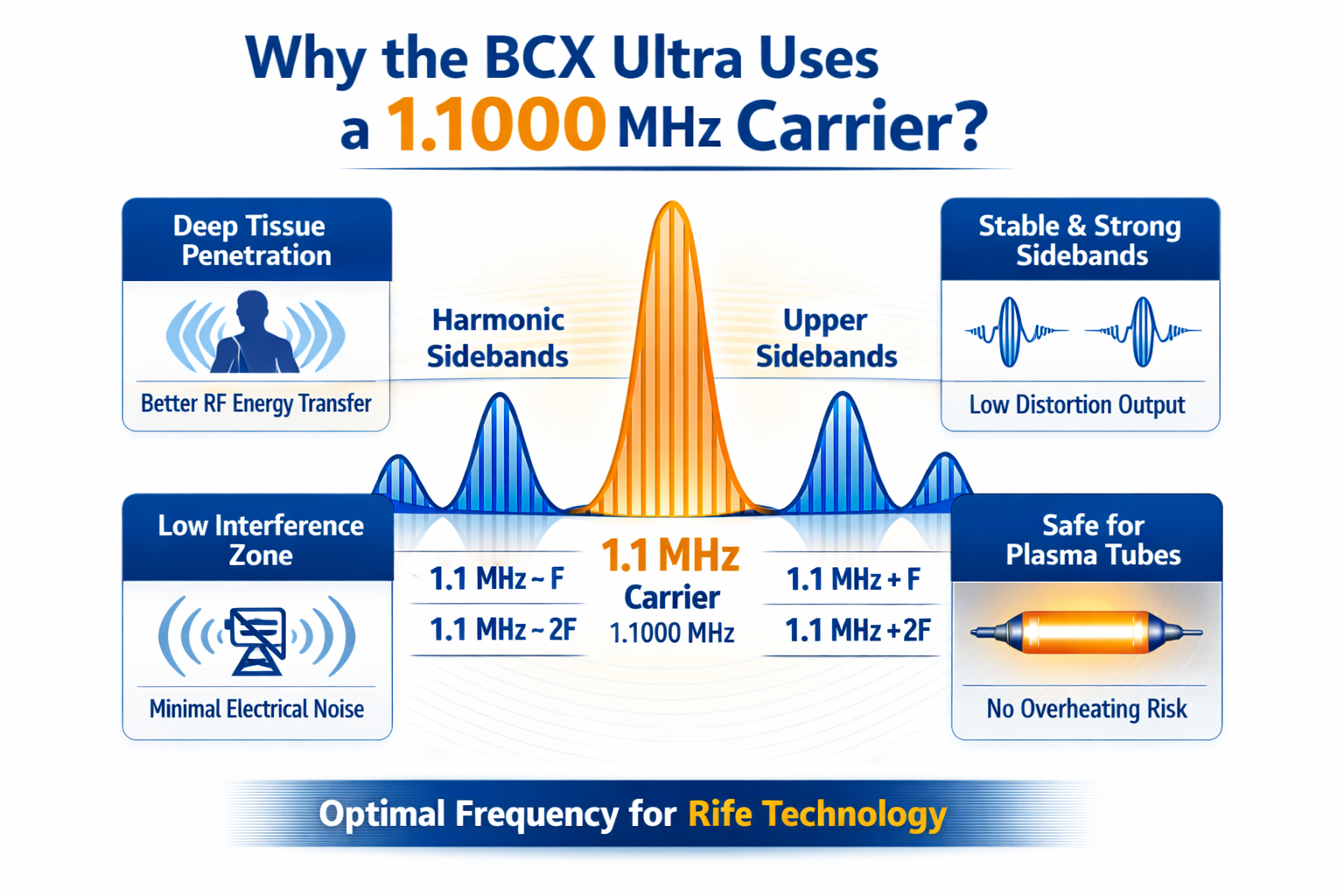
The BCX Ultra uses a 1.1000 MHz carrier because it provides the best balance of deep penetration, clean sidebands, low distortion, and stable output. Around 1 MHz is a proven RF range used in medical and bio‑electromagnetic devices because it transfers energy efficiently into the body. It’s also a safe frequency for plasma tubes and avoids electrical interference.
The BCX Ultra keeps 1.1 MHz as the default because it’s reliable and effective, but you can change the carrier at runtime, in custom programs, or in the Master Defaults if you want to experiment with different methods.
1. 1.1 MHz PENETRATES DEEPER INTO TISSUE
Higher RF carriers penetrate better than low-frequency audio waves.
Around 1 MHz is widely recognized in bio‑electromagnetic engineering as an ideal range for:
- deeper tissue reach
- stable energy transfer
- minimal surface heating
This is why medical diathermy devices also operate around 1 MHz.
2. PRODUCES CLEAN, STRONG SIDEBANDS
When you run a frequency on a carrier wave, you generate sidebands.
Sidebands are useful only when they are strong and symmetrical.
A 1.1 MHz carrier produces:
- strong, stable sidebands
- minimal distortion
- predictable harmonic structure
This is important because Rife’s original equipment used RF carriers, not audio-only output.
3. AVOIDS INTERFERENCE AND NOISE
1.1 MHz sits in a “quiet” RF region:
- low electrical noise
- minimal interference from AM radio
- stable across different environments
This keeps the output clean and consistent.
4. It’s safe for plasma tubes and electronics
Plasma tubes and high‑voltage circuits have limits.
Too high of a carrier can:
- overheat tubes
- stress transformers
- reduce lifespan
Too low of a carrier reduces penetration and sideband strength.
1.1 MHz is the proven safe, high‑performance middle ground.
5. IT MATCHES HISTORICAL RIFE ENGINEERING PRINCIPLES
Rife’s original equipment used RF carriers in the 1–4 MHz range.
The BCX Ultra stays aligned with that engineering tradition while optimizing for:
- modern components
- safety
- stability
- consistent output
6. FINALLY IMPORTANTLY — BCX LETS YOU CHANGE IT
Unlike many machines that lock you into one carrier, the BCX Ultra allows:
- runtime carrier changes
- custom program carriers
- Master Default carrier changes
This is why researchers love the BCX — it’s flexible.
Short Answer:
Because 1.1000 MHz (1.1 MHz) is the sweet spot where you get deep penetration, stable modulation, low distortion, and compatibility with both plasma and contact accessories. It’s a proven, reliable RF frequency that delivers strong, clean sidebands without overheating components or causing interference.