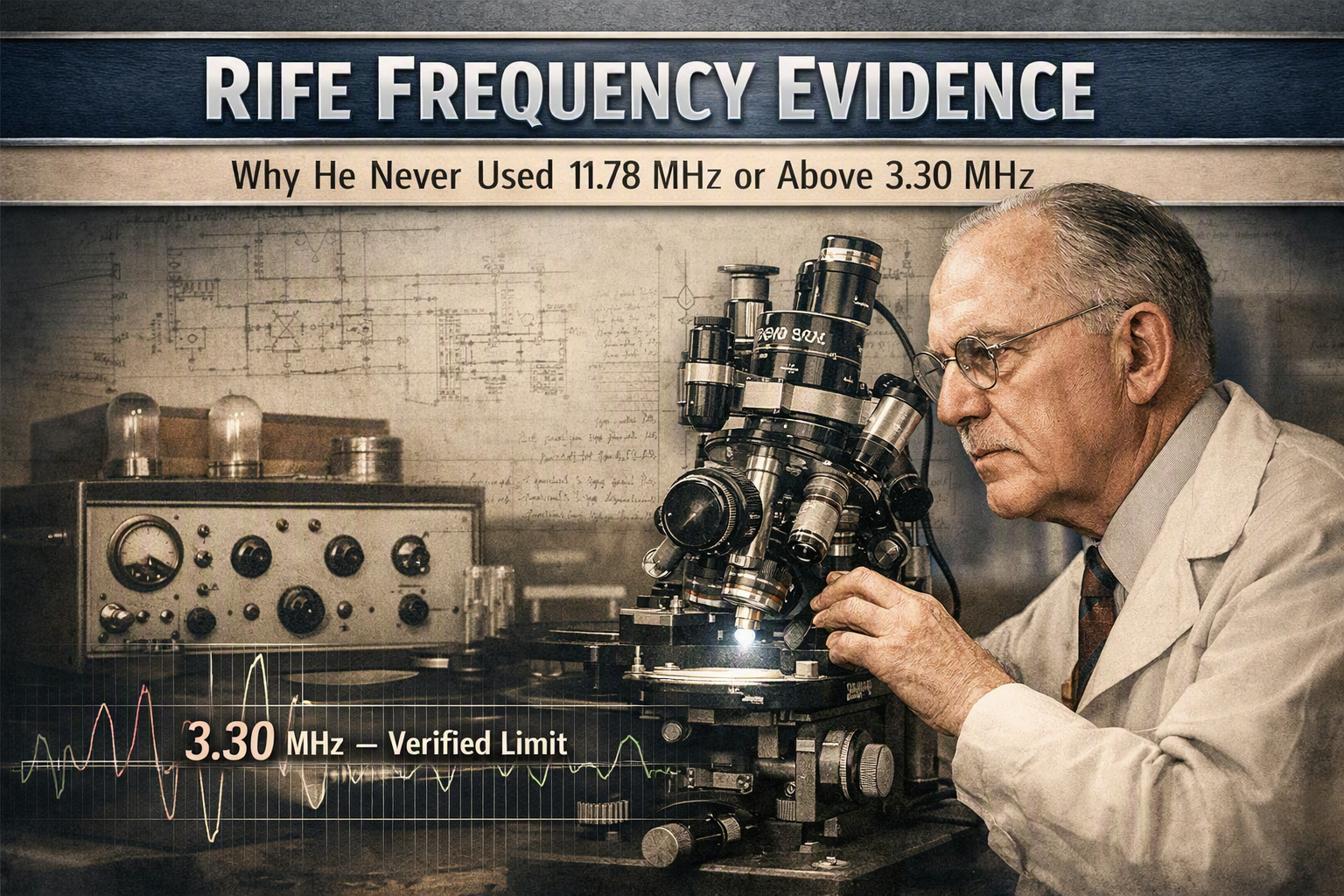
Royal Rife’s True Frequency Range:
Sources claiming that Royal Rife used frequencies above 3.30 MHz are based on modern misinterpretations of old documents. The highest verified carrier frequency in Rife’s actual work was 3.30 MHz. This is why no legitimate Rife system, including the BCX Ultra, uses 11.78 MHz; it was never part of Rife’s engineering. Note: A carrier wave must always be higher than the frequency it is carrying.
Why the Rife’s BX Frequency “11.78 MHz” is incorrect?
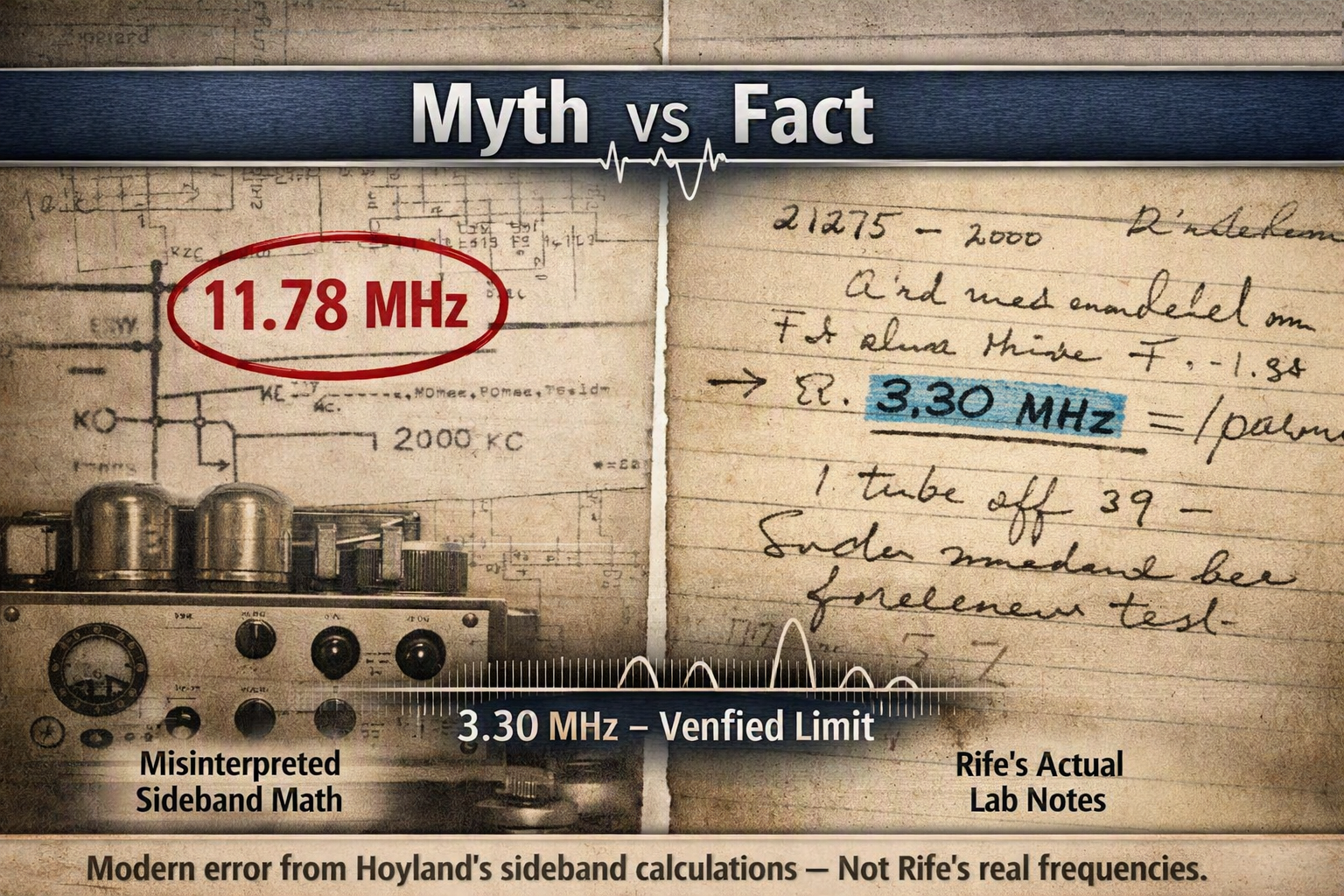
A few books and websites mistakenly list 11,780,000 Hz (≈ 11.78 MHz) as Rife’s “BX frequency.” This error comes from:
- Misinterpreting sideband math
- Confusing audio frequencies with RF carrier frequencies
- Typographical errors repeated online
But in Rife’s original lab notes, engineering logs, and the Hoyland-era schematics, no such frequency exists.
Where the confusion came from: Philip Hoyland
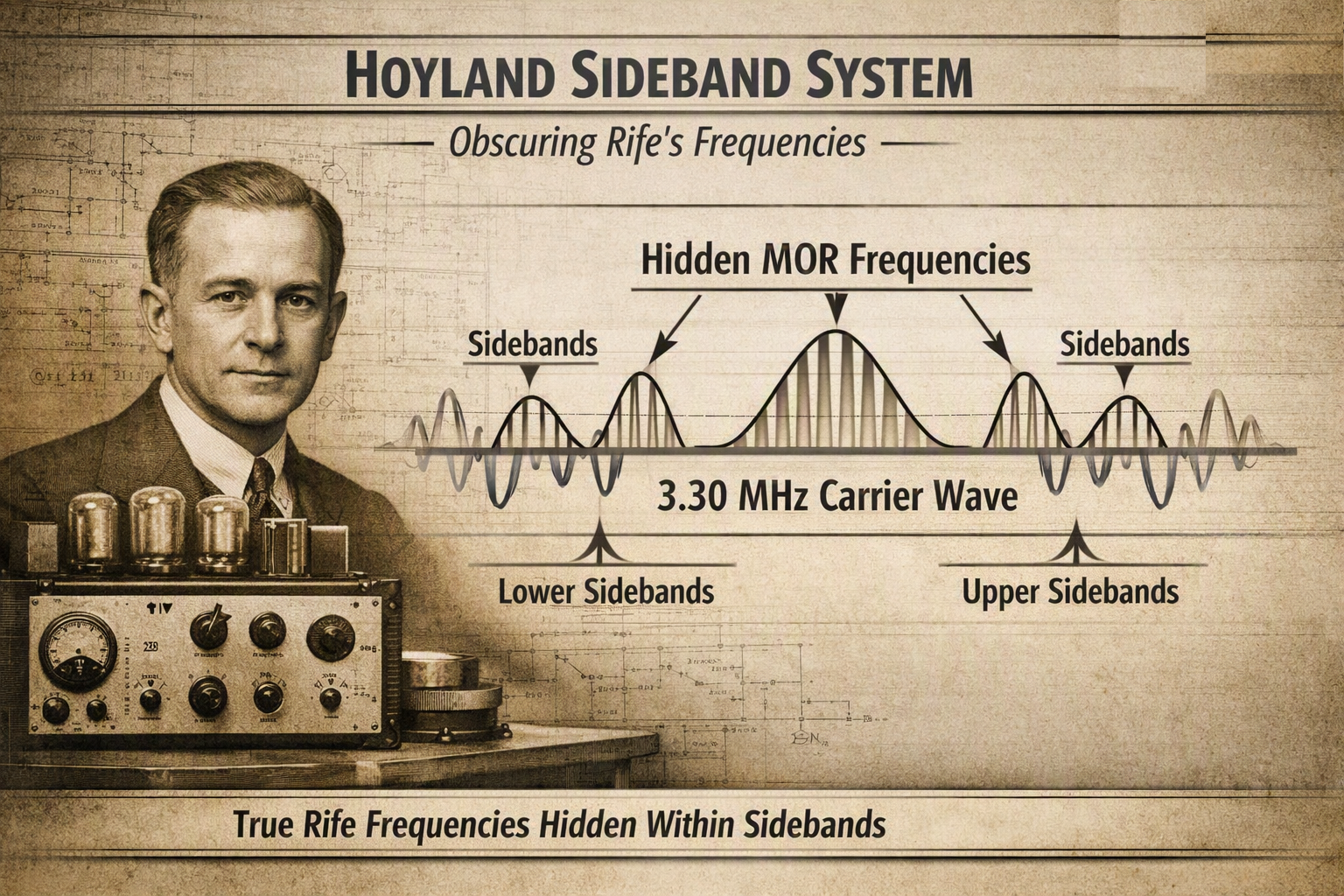
Philip Hoyland was Rife’s engineer in the mid‑1930s. He changed Rife’s original method and introduced a completely different system:
Hoyland replaced Rife’s direct frequencies with a carrier‑wave/sideband system
- Rife originally used direct audio frequencies (hundreds to thousands of Hz).
- Hoyland switched to a 3.30 MHz carrier wave and then hid the real frequencies inside sidebands.
- He intentionally obscured the true MOR frequencies so competitors could not copy the machine.
Hoyland’s sideband math created large numbers
When you calculate sidebands around a 3.30 MHz carrier, you get huge mathematical values. Some modern writers mistakenly treat these calculated numbers as if they were actual operating frequencies.
This is where the myth of 11,780,000 Hz (11.78 MHz) came from. But Hoyland’s machine never output that frequency, and neither did Rife.
Rife rejected Hoyland’s approach
Rife eventually fired Hoyland. Their relationship collapsed, and it led to a lawsuit — all documented in court records. Rife did not approve of Hoyland’s sideband‑based method.
He believed Hoyland’s approach:
-
- hid the true frequencies
- weakened the power of the treatment
- deviated from his original research
What Royal Rife actually used
Carrier wave (RF)
-
- Highest documented: 3.30 MHz
- Never above 4 MHz
- Never 11.78 MHz
Treatment frequencies (MORs)
-
- Audio frequencies (Hz to kHz)
- Modulated onto the carrier to create sidebands
- The sidebands were the active biological component — not the carrier itself
Why the BCX Ultra does NOT use 11.78 MHz
Because:
-
- Rife never used it
- Hoyland never used it
- It is a mathematical artifact, not a real frequency
- It has no verified biological effect
- It is outside the safe operating range of raytubes
- It is not part of any authentic Rife or Hoyland documentation
The BCX Ultra uses:
-
- Rife’s original audio MORs
- The validated BX/BY sets
- Modern cancer programs that outperform relying on a single BX frequency
Why Rife Practitioners Use Lower Harmonics (Real MORs)
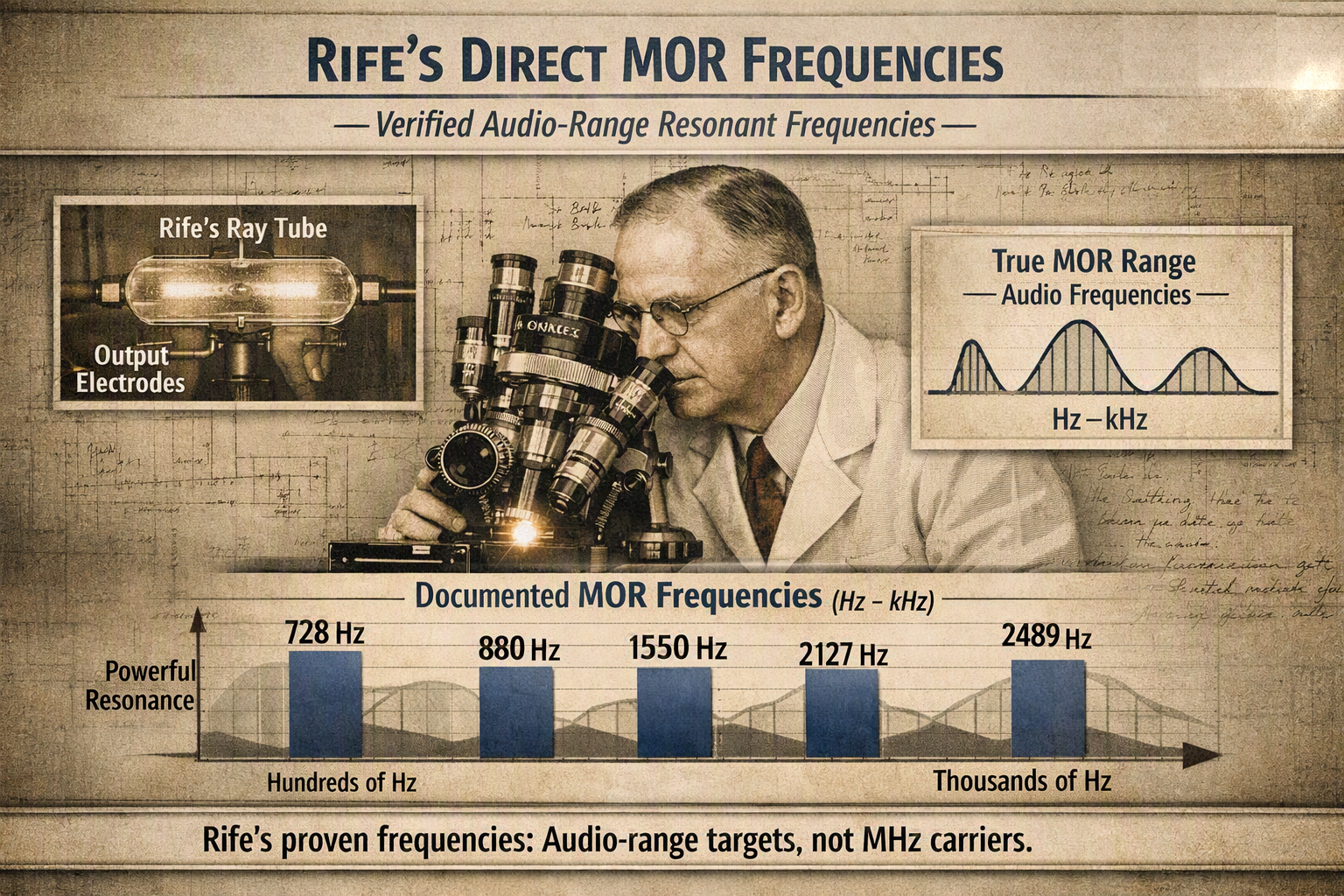
The lower harmonics are the actual frequencies Rife identified. Rife’s original work used audio‑range frequencies (hundreds to thousands of Hz). These were the true MORs (Mortal Oscillatory Rates) he discovered under the microscope. The higher numbers people see online (millions of Hz) are mathematical artifacts, not real operating frequencies.
- Lower harmonics penetrate biological tissue more effectively
- Practitioners use the lower harmonics because:
-
- They couple better into biological tissue
- They produce stronger resonance effects
- They match the frequencies Rife actually observed destroying organisms
- They are safe and stable for raytubes and electrodes
- High MHz frequencies:
-
- Don’t penetrate deeply
- Don’t produce the same biological resonance
- Are not part of Rife’s documented work
- Are outside the safe operating range of plasma tubes
- The lower harmonics are reproducible and verifiable
- Rife’s original audio frequencies:
-
- Can be reproduced on modern equipment
- Produce consistent results
- Match historical lab notes
- Match modern frequency research
- Are used by every serious Rife practitioner worldwide
Conclusion
The high MHz numbers cannot be reproduced because they were never real operating frequencies.